

AI Recruiting and Interview Platform
Hire better talent with AI
What is Biviu AI?
Biviu AI is an AI-powered hiring platform that helps companies manage recruitment from requisition to hiring decision, with AI support across job setup, candidate screening, interviews, evaluation, and offer workflows. One flow connects hiring managers, recruiters, HR, finance, interviewers, and candidates, from the hiring request through to the signed agreement.

Hiring shouldn't feel like manual work
Recruitment teams spend too much time on repetitive, operational hiring tasks. Biviu automates and structures the repetitive parts, so teams can focus on making better hiring decisions.
Hiring run by hand
- Hiring requests are often incomplete or inconsistent
- Job descriptions take time to prepare and align
- Recruiters manually screen large volumes of CVs
- First-round interviews are repetitive and hard to scale
- Interview evaluations are often inconsistent
- Candidate decisions take too long
- Offer and agreement processes are still fragmented
Hiring run on Biviu
- A structured requisition and approval flow
- An AI-generated job description draft
- AI-assisted screening on every application
- AI voice and video interviews, on the candidate's own time
- One rubric, one AI-structured score and summary
- An AI-ranked candidate dashboard with recommendations
- One offer and agreement workflow, through to signing
From hiring request to signed agreement
Biviu connects hiring managers, recruiters, HR, finance, interviewers, and candidates in one recruitment flow.
- 1
Create requisition
The role starts as a structured request
A hiring request is raised on a form rather than in a document or a chat thread, so nothing needed to open the role is missing.
- 2
Approve hiring request
Approval happens inside the platform
The request routes to its approvers, and every stage change is written to an audit log and can be reversed.
- 3
Generate and publish job
From approved requisition to live opening
AI turns the approved requisition into a ready-to-publish job opening — responsibilities, requirements, and the evaluation rubric — then posts it to every connected job board and channel at once.
- 4
Receive candidate applications
Every application lands in one pipeline
Candidates submit an application and a CV, and the system builds the full candidate profile around it: CV, consent, documents, and notes.
- 5
Screen CVs with AI
Every applicant reviewed, with evidence
Biviu reviews every application against the job requirements, produces a screening score and a recommendation, and ranks candidates for the recruiter to review.
- 6
Run AI and human interviews
AI takes the first round
Qualified candidates take a structured AI interview on their own time. For the human rounds that follow, interviewer availability is matched to the candidate's slots automatically.
- 7
Create and approve offer
The decision becomes an offer
Once the team picks a candidate, the offer is created and approved in the same pipeline the rest of the hire ran in.
- 8
Generate agreement and mark as hired
Through to signing
Biviu generates the agreement, collects acceptance and signature, and closes the candidate out as hired.
Built to take work off HR and interviewers
The hiring journey stays the same. The manual load on the two teams running it does not.
No more reading every CV
HR and recruiters — AI ranks applicants against the job requirements.
First-round interviews run without you
HR and recruiters — interviews run on the candidate's own time. No scheduling, no repeat sessions.
One place for status and history
HR and recruiters — requisitions, candidates, offers, and approvals in one pipeline.
Fewer, better interviews
Interviewers — only candidates who passed AI screening and the AI interview.
Walk in already briefed
Interviewers — score, AI summary, strengths, and gaps are ready.
Availability instead of email threads
Interviewers — set your slots once. Scheduling and feedback happen in the platform.
Everything the hiring team needs
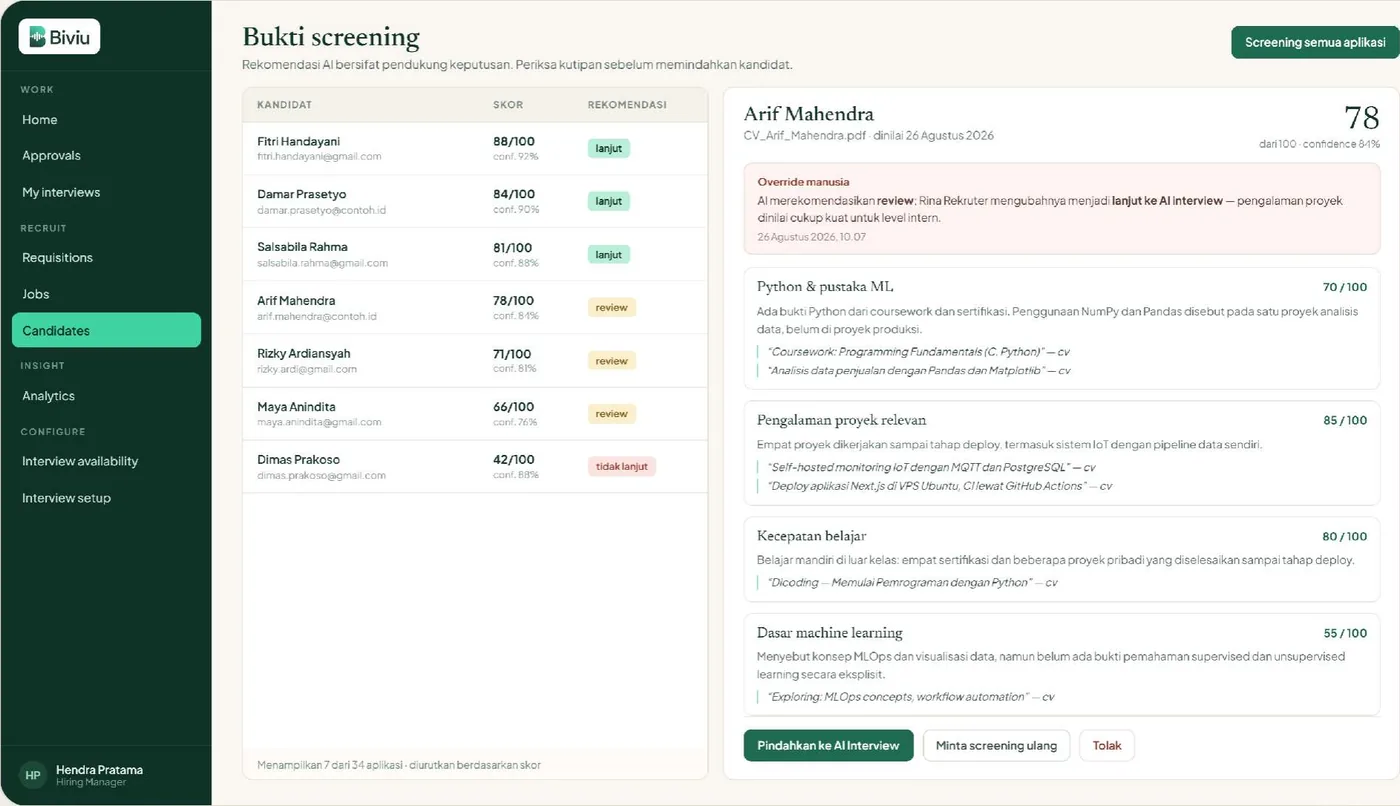
Screen CVs with AI
Biviu reviews every application against the job requirements and ranks candidates with evidence. Recruiters spend less time reading every CV manually and more time reviewing qualified candidates.
- Candidate submits application and CV
- System creates candidate profile
- AI reviews CV against job requirements
- AI screening score and recommendation
- Recruiter reviews the AI result
- Advance, reject, or send for further review
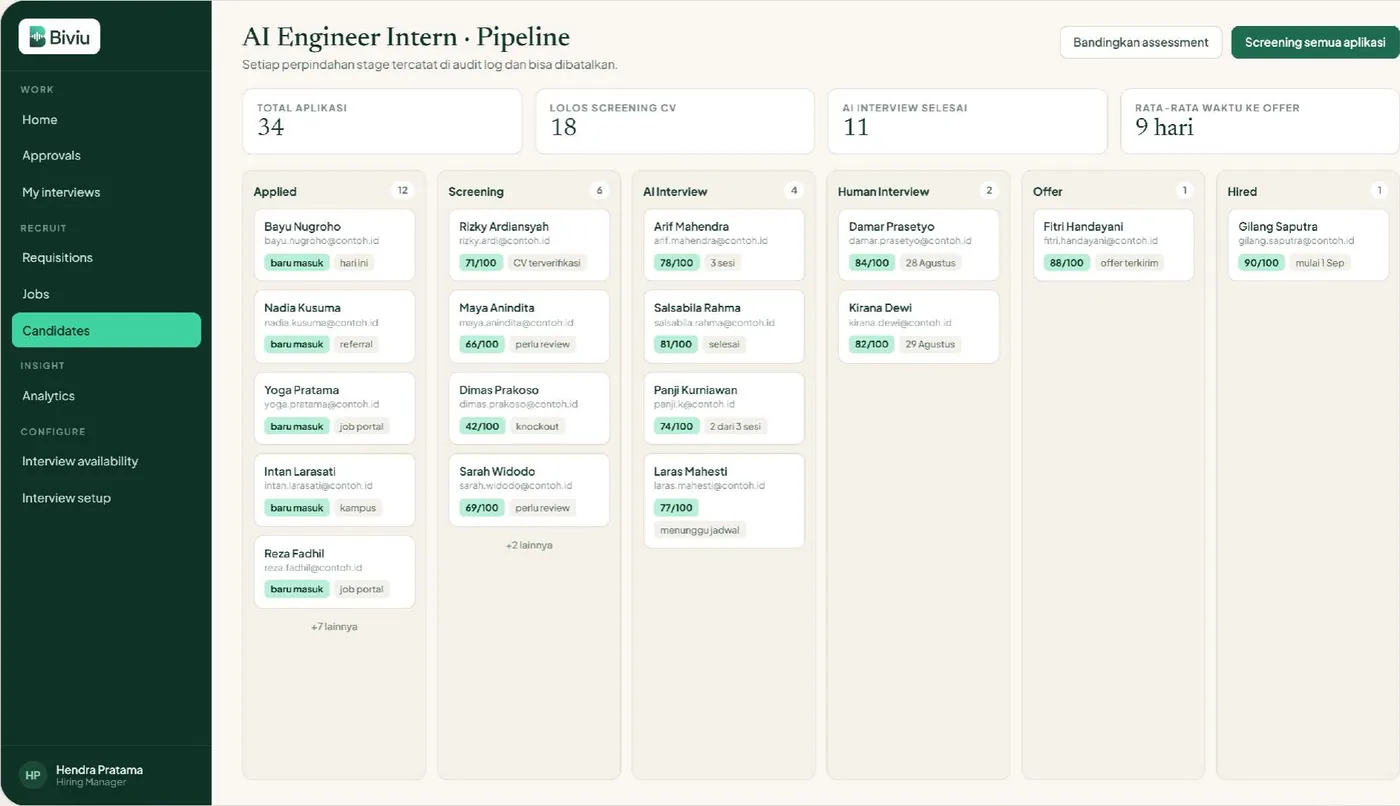
One ATS for the whole pipeline
Requisitions, candidates, interviews, offers, and hiring status sit in one pipeline the whole team can see. Hiring status stops living in spreadsheets and chat threads: every move is visible, logged, and reversible.
- Structured requisition and approval flow
- Candidate pipeline from applied to hired
- Full candidate profile: CV, consent, documents, notes
- Assessment journey and timeline per candidate
- Recruiter notes and human overrides
- Audit trail on every stage change
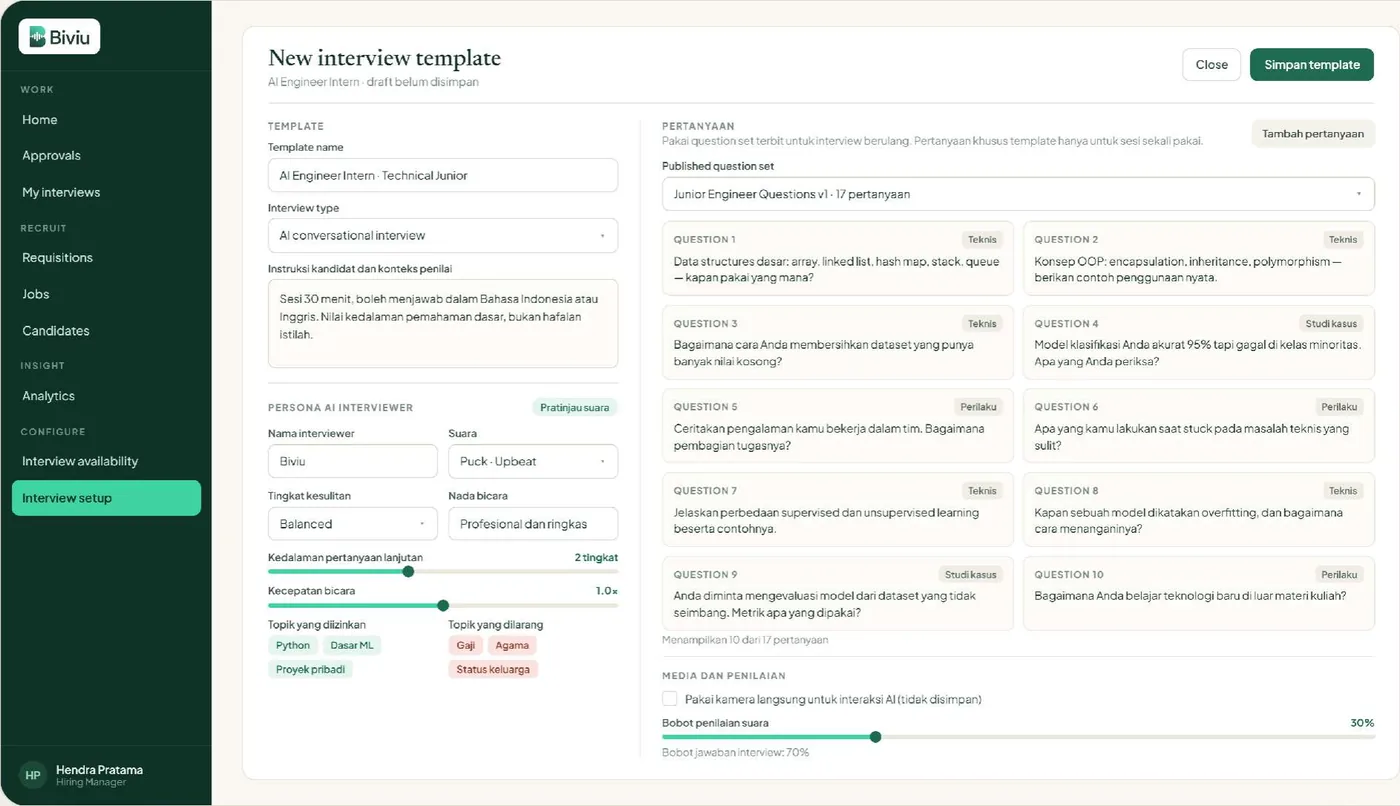
Generate questions and tune the AI interviewer
Set the question set, difficulty, and interviewer persona per role, then reuse it for every candidate. Hiring teams decide how hard and how formal the interview is, and what the AI is never allowed to ask.
- AI generates the question set from the job and rubric
- Tag questions as technical, behavioural, or case study
- Reuse a published question set across repeat hiring
- Set difficulty level and follow-up depth
- Choose interviewer voice, tone, and speaking pace
- Allow or forbid topics — salary, religion, family status
- Weight voice delivery against answer content
AI interviews by voice and video
Structured, role-based interviews on the candidate's own time, recorded and transcribed for review. Every candidate gets a consistent first-round experience, without requiring recruiter scheduling time.
- AI interview invitation with a deadline
- Candidate joins through an interview link
- AI guides the candidate through the interview
- Structured and follow-up questions
- Voice and video captured with consent
- Live transcript generated during the session

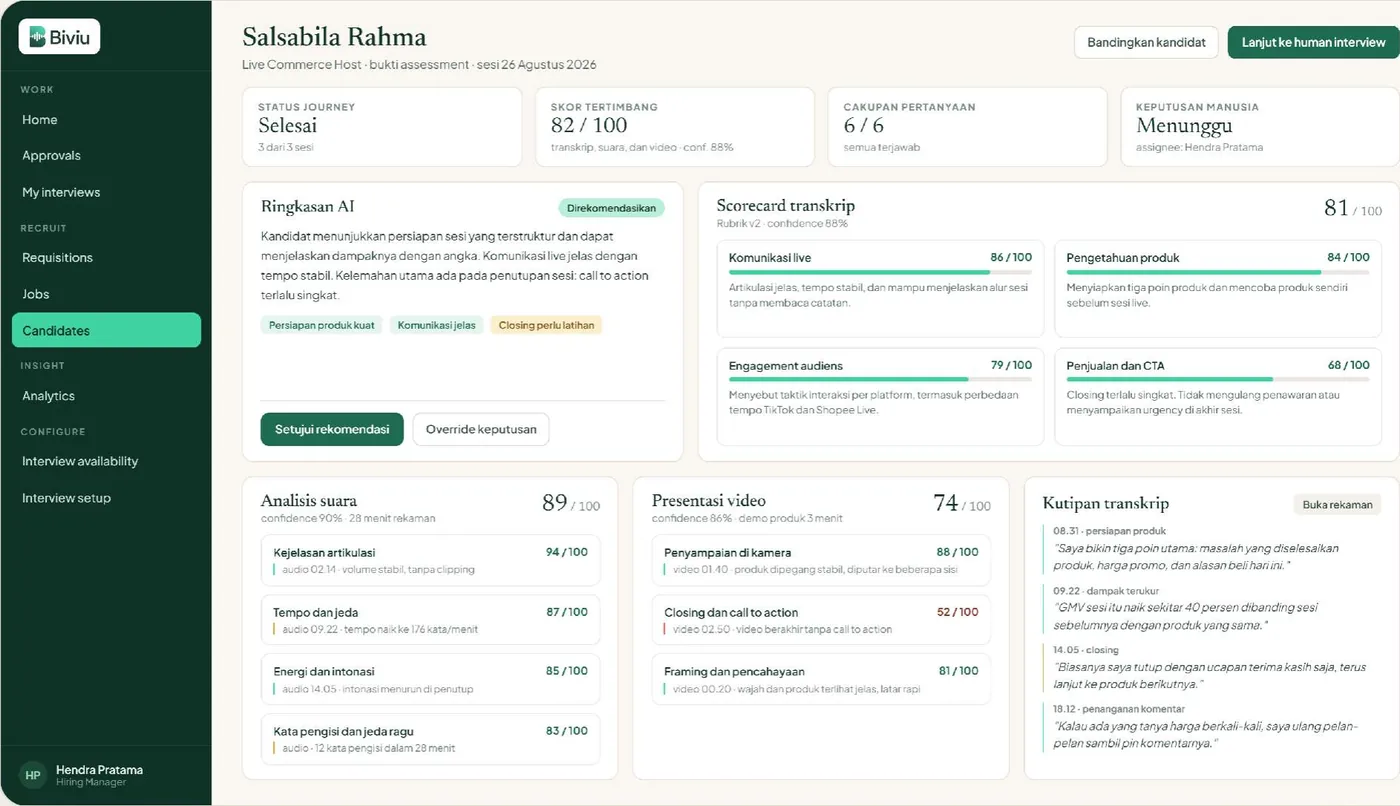
Candidate AI evaluation
Interview outputs become a structured scorecard: transcript, voice, and video scored on the same rubric. Hiring teams compare candidates on the same criteria, instead of relying on scattered notes or subjective impressions.
- Weighted score across transcript, voice, and video
- Rubric-based scorecard per criterion
- AI summary with strengths and improvement areas
- Confidence score on every assessment
- Quoted transcript evidence with timestamps
- Human decision: approve the recommendation or override it
Not just interviews — the rest of the hiring flow is covered too
The steps before screening and after the decision are part of the same platform.
Generate job descriptions with AI
Turn an approved requisition into a ready-to-publish job opening — responsibilities, requirements, and the evaluation rubric drafted for you.
Autopost to all recruitment channels
Publish one job opening to every connected job board and channel at once, with applications flowing back into the same pipeline.
AI scheduling for user interviews
Match interviewer availability to candidate slots automatically, send the invites, and collect feedback in one place.
Manage offers and agreements
Move from candidate decision to formal hiring completion: offer approval, acceptance, agreement generation, and signing.
Better hiring outcomes
Eight gains across the hiring flow, in four areas. Biviu helps teams hire faster without losing structure, consistency, or control.
Speed
A faster screening process, and a lighter recruiter workload.
Consistency
More consistent candidate evaluation, and better candidate comparison.
Control
A clearer hiring approval flow, and a structured audit trail.
Confidence
An improved candidate experience, and more confident hiring decisions.
Traditional hiring is manual
Biviu makes the same nine steps structured and AI-assisted.
| Capability | Traditional hiring | Biviu |
|---|---|---|
| Hiring requisition | Manual docs and chat | Structured requisition flow |
| Job description | Written manually | AI-generated draft |
| CV screening | Manual review | AI-assisted screening |
| First interview | Recruiter-led | AI voice interview |
| Candidate evaluation | Subjective notes | AI-structured score and summary |
| Candidate comparison | Manual, via spreadsheet | AI-ranked dashboard with recommendations |
| Interview scheduling | Manual coordination | Availability-based scheduling |
| Offer process | Fragmented | Offer and agreement workflow |
| Audit trail | Scattered | Centralised log |
Common questions about Biviu AI
Does the AI reject candidates on its own?
No. Autonomous rejection is disabled by default and requires a recruiter decision. Screening and scoring are decision support — a recruiter approves the recommendation or overrides it, and the final hiring decision stays with an authorised person.
How does the scoring work?
Every candidate is assessed against the same rubric you configure, with a weighted score across the transcript, the voice delivery, and the video. Each score links back to its evidence — a quoted transcript passage with a timestamp, a rubric item, or a system event — and carries a confidence figure, so a recruiter can always see why a score was given.
What languages does the interview support?
Any language. The question set and the candidate instructions are set per interview template, so the same role can be run in Bahasa Indonesia, in English, or in both.
What does the candidate actually do?
They apply and submit a CV, then open an interview link and complete a structured AI interview at a time that suits them. The AI guides them through it and asks follow-up questions, voice and video are captured with consent, and a live transcript is generated during the session. It is built mobile-first, so there is nothing to install.
Build your AI hiring engine with Biviu
Tell us how you hire today. We will show you what Biviu takes off your recruiters, and say so plainly if it is not the right fit.
- Screens and ranks every CV against the job requirements
- Runs first-round AI interviews by voice and video
- One pipeline from requisition through to signed agreement